November 04, 2026
The end of the fog of AI
For years every AI product roadmap had a very short shelf-life due to models capabilities evolving faster than any 6+ months plan you could build on top of them. That's what I called the fog of AI. A real challenge for product teams as it made long-term vision alignment harder than in pre-AI tech companies.
But something has changed. I posit that since August this year, frontier models have fully saturated knowledge work. The move from GPT 5.6 to 6 was it. As someone passionate about formal maths and auto-formalization, GPT 6 was a massive bump compared to GPT 5.6, a completely different ball game. But as software engineer and co-founder, I barely noticed a difference in my day-to-day work.
GPT 6 is demonstrably better than GPT 5.6 at most tasks, but I didn't see much difference because my work has been fully saturated by the frontier. Basically the frontier has escaped most knowledge work and from now on we won't make much difference between new models in our day-to-day work.
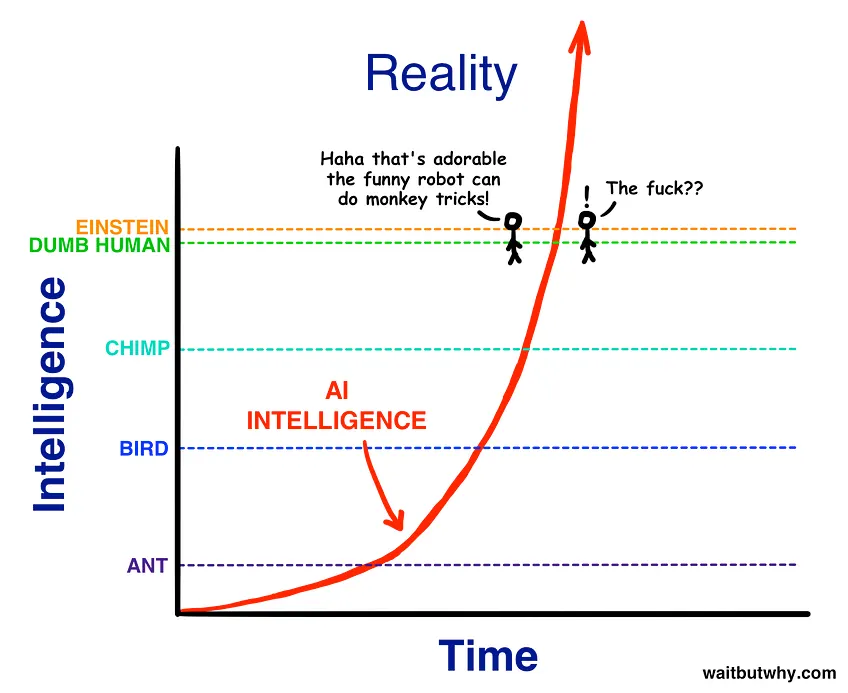
It does not mean that the frontier won't be useful. It will bring us new physics, new maths, new cures. It has the potential to accelerate our societies in ways that we could only dream of. But that's a replacement/acceleration of science not the work (that most of us do) that runs our economies.
At the same time the iso-capability price of the efficient frontier keeps falling (a deeper look at the data here: [0]). Economically productive intelligence cost is going to ~zero, and it will be plentiful.
Three important consequences:
(i) Intelligence will commoditise fast OSS models lag frontier models by ~6m. If the frontier has saturated knowledge work in August, that means OSS models will saturate it by Feb 2027. From there on, intelligence is plentiful and we will hardly make a difference between one model and another (except maybe for speed and price).
(ii) Value accrues at the product layer Most errors in agents today are not due to a lack of intelligence, but rather a lack of context or tools. This is product problem, not a science problem anymore.
(iii) The Fog of AI has lifted AGI is here. Intelligence for work is above human level and plentiful. The fog has dissipated and it's now possible to build against long-horizon plans.
Side note: There are many deep questions on the upcoming valuations of AI labs in a world where knowledge-work level intelligence is commoditised with a frontier on an escape trajectory. I see a justification for a 2T ANT/OAI in that world as the frontier will be shaping geopolitics and pushing entire continents into the future. But! The next stop to watch out is self-improvement (which ANT/OAI want us make believe that it is around the corner). Will AI labs lock down before they get there to prevent OSS to catch-up? Once/if self-improvement is commoditised, it all boils down to energy and inference capability. Many cards on the table, unclear how the game will unfold. I still want to thank OAI and ANT for burning through bilions of dollars to offer AGI[1] to the world for free :grimacing:
So what's still broken?
First, tying your harness to a single source of intelligence is broken. It makes absolute no sense if you even remotely accept the premises above. It's like buying machines for a factory that can only plug into one source of energy. You want to build your harness, your process, your context, basically the way you work on top of a substrate that can source the cheapest and fastest intelligence at any given time.
Second, collaboration with agents is still broken. We are still using single-player agents interacting through legacy product surfaces that were not built for agentic work and this new shape of collaboration. It makes no sense to interact through products like Notion, Google Workspace or Sharepoint to do the work with agents. Additionally, agents are taking longer and longer time-horizon tasks: likely days of human equivalent work right now and soon weeks (if we believe METR smoothness). If you think of any such task in the enterprise, except for very rare exceptions, these tasks are inherently cross-functional and collaborative. It means the steering has to become collaborative. Which means that running agents on your machine is from now on, plain broken as well.
So what's next? What got revealed by the dissipating fog?
Well the opportunity is to reinvent the productivity suite for the post-agentic era from the ground up. Every productivity surface we've used for the past decades have to be scratched out and replaced by new products that are built for agentic work at their core.
At Dust, we are witnessing interesting early signs of that big "displace and replace" ongoing phenomenon:
(i) Frames, which are agent generated shareable visual artefacts are replacing slides (the iso-capability evolution link is a Frame[0]). Think about it. The atomic action of working with slides and Powerpoint is to trace a rectangle and write text in it. The atomic action of building frames is to steer an agent. The two have nothing to do. There is no rectangle tracing at all in Frames, and yet, one displaces the other where Dust is being used.
(ii) Agent maintained business apps are replacing spreadsheets and Notion databases. Spreadsheets and Notion database have been built with very rigid constraints that enabled non-coding people to build software driven processes. The trade-off made perfect sense. It does not anymore. In a world where code is free we can free every employe from these constraints and let them build much richer processes to accelerate their work. We're seing dozens and dozens of spreadsheet business processes being replaced and enriched by such agent maintained apps.
We're particularly excited about productivity but the opportunity above goes beyond that. LLMs are now stable enough (from our human perspective) that we can plan for the long term. Every product, every process out there is ripe for a reinvention with agents at their core. The frontier has escaped, leaving behind it a stable infrastructure on which the interesting work begins: building the best products to transform, accelerate and re-invigorate our economies.
This is the end of the Fog of AI, and it's all about product again \o/
[0]
https://app.dust.tt/share/frame/ae6a76cc-1dcb-4c03-b9fd-b3ee47626e29
[1] By all plausible definitions we set for
ourselves last decade, we have AGI. It's a done deal and that toothpaste
is not getting back into the tube. Even if labs locked down their models
today, I think OSS catches up anyway. The next question is where are we
on the spectrum between AGI and ASI? And is ASI tied to self improvement?